
Showing posts with label Non-Fiction Category: Language and Literature. Show all posts
Showing posts with label Non-Fiction Category: Language and Literature. Show all posts
Thursday, December 2, 2010

Tuesday, May 4, 2010
Non-Fiction: Carol Shields
 Jane Austen: A Biography
While many are familiar with Jane Austen's novels, the details of her life are less well known. In this addition to the Penguin Lives series, biographer Shields draws from Austen's witty letters and classic novels to combat the notion that Austen lived a placid, uneventful life. Raised in a large family by intelligent parents, Austen's creativity flourished. She and her siblings were known to put on plays, and she found a ready audience for her fiction in her family. Her writing developed from outrageously witty and satirical juvenilia to a subtle and graceful maturity in her novels. Meanwhile, Austen's life was anything but dull; balls, parties, broken or tragically ended engagements, and family scandals occupied Jane and sister Cassandra's time. Shields explores popular Austen stories, such as her attraction to and subsequent separation from an eligible bachelor and her 24-hour engagement to a different man. Although Shields suggests that Austen's unmarried state might have been a source of disappointment for her, Shields also shows how important Austen's literary successes were to her. A thoughtful introduction to an important and influential writer. Kristine Huntley Copyright © American Library Association. All rights reserved
Monday, May 3, 2010
Non-Fiction: Tom Shippey
 J.R.R.Tolkien: Author of the Century
In a wonderfully readable study aimed at not just the Tolkien fan but any literate person curious about this fantasy author's extraordinary popularity, British scholar Shippey (The Road to Middle-earth) makes an impressive, low-key case for why the creator of Middle-earth is deserving of acclaim. (Recent polls in Britain have consistently put The Lord of the Rings at the top of greatest books of the century lists.) Having taught the same Old English syllabus at Oxford that his subject once did, Shippey is especially well qualified to discuss Tolkien's Anglo-Saxon sources, notably Beowulf, for the elvish languages and names used in the fiction. The author's theory on the origin of the word hobbit, for example, is as learned as it is free of academic jargon. Even his analyses of the abstruse Silmarillion, Tolkien's equivalent of Joyce's Finnegans Wake, avoid getting too technical. In addition, Shippey shows that Tolkien as a storyteller often improved on his ancient sources, while The Lord of the Rings is unmistakably a work of its time. (The Shire chapters, like Orwell's 1984, evoke the bleakness of late-'40s Britain.) In treating such topics as the nature of evil, religion, allegory, style and genre, the author nimbly answers the objections of Tolkien's more rabid critics. By the end, he has convincingly demonstrated why the much imitated Tolkien remains inimitable and continues to appeal. Copyright 2001 Cahners Business Information, Inc.; from Publishers Weekly
Non-fiction: Northrop Frye and Jay Macpherson
 Biblical and Classical Myths: The Mythological Framework of Western Culture
 In the 1970s and 80s, Northrop Frye and Jay Macpherson co-taught a very influential course at the University of Toronto's Victoria College on the history of Western mythology Frye focusing on the biblical myths; Macpherson on the classical. Biblical and Classical Myths recreates the thought behind that course, with Frye's lectures unpublished until very recently supplemented by Macpherson's popular 1962 textbook on classical mythology, Four Ages: The Classical Myths.
Frye's lectures on the Bible make up the first half of the book. He expounds on an array of topics, including translations of the bible, sexual imagery, pastoral and agricultural imagery, and law and revolution in the bible. Four Ages makes up the second half. Macpherson narrates the major classical myths from stories of creation to the myths' survival in later European traditions.
By complementing the biblical tradition with the classical, this volume imparts a comprehensive understanding of western mythology. With a preface by Alvin Lee, general editor of the Collected Works of Northrop Frye, Biblical and Classical Myths is an essential volume and represents a unique achievement in scholarship. from product description
Non-Fiction: Lynne Truss
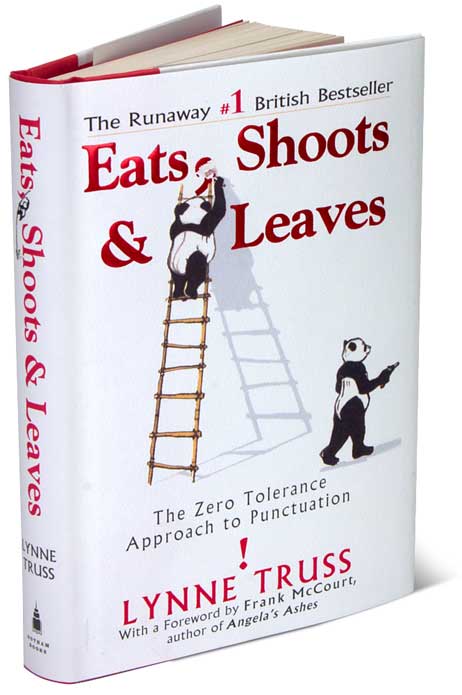 Eats, Shoots and Leaves
This impassioned manifesto on punctuation made the best-seller lists in Britain and has followed suit here. Journalist Truss gives full rein to her "inner stickler" in lambasting common grammatical mistakes. Asserting that punctuation "directs you how to read in the way musical notation directs a musician how to play," Truss argues wittily and with gusto for the merits of preserving the apostrophe, using commas correctly, and resurrecting the proper use of the lowly semicolon. Filled with dread at the sight of ubiquitous mistakes in store signs and headlines, Truss eloquently speaks to the value of punctuation in preserving the nuances of language. Liberally sprinkling the pages with Briticisms ("Lawks-a-mussy") and moving from outright indignation to sarcasm to bone-dry humor, Truss turns the finer points of punctuation into spirited reading. Joanne Wilkinson Copyright © American Library Association. All rights reserved
Non-Fiction: Gilliver, Marshall & Weiner
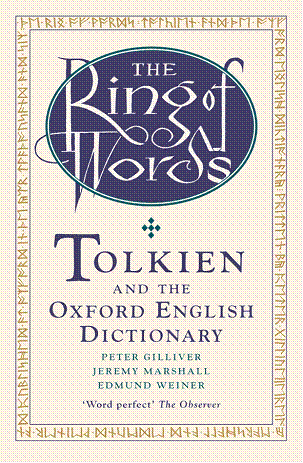 The Ring of Words: Tolkien and the Oxford English Dictionary
The Ring of Words describes the powerful and unique relationship between Tolkien's creative use of the English language in his fictional works and his professional work on the Oxford English Dictionary. Tolkien's earliest employment was as an assistant on the staff of the OED, and he later said that he had 'learned more in those two years than in any other equal period of [his] life'. Here three authors, themselves senior editors of the OED, engage directly with Tolkien's language and his fictional world. Two discursive sections explore Tolkien as a lexicographer and his creativity as a word user and creator. The main section of the book is made up of individual 'word studies' which explore over 100 words found in Tolkien's fiction in terms of their origins, development, and significance in his fictional world. Words such as 'hobbit', 'attercop', 'precious', 'Smeagol', and 'waybread' are explored in fascinating detail. The Ring of Words offers a new and unexplored angle on the creative world of one of our most famous and well-loved writers, presenting new archive material for the first time. from product description
Non-Fiction: Jane Urquhart (Extraordinary Canadians series)
 Lucy Maud Montgomery
New material about the private life of Lucy Maud Montgomery has prompted a searching look at the beloved author of Anne of Green Gables. While her fictional characters inhabited a world where love and close community bonds overcame all tribulations, Montgomery's real life was marked by grief and loneliness. Married to a clergyman who suffered from a debilitating mental illness, Montgomery struggled to keep up appearances in a Victorian society that valued propriety at all costs. As she aged, depression engulfed her; nonetheless, throughout her life, she maintained her prolific output of fiction, attracting ever-increasing numbers of fans. Acclaimed novelist Jane Urquhart has written several novels centring on the role of the artist. Here, she explores the life of a woman whose successful literary career broke the boundaries set for women of her time, but who could not escape the societal strictures of Victorian Canada or her own demons. from product description
Non-Fiction: Margaret Macmillan (Extraordinary Canadians series)
 Stephen Leacock
Canada's foremost historian, Margaret Macmillan, examines the life of a great humorist, Stephen Leacock. Stephen Leacock's satiric masterpiece Sunshine Sketches of a Little Town captures "the Empire forever" mentality that marked Anglo-Canadian life in the early decades of the twentieth century. Historian Margaret Macmillan—whose books Women of the Raj and Paris 1919 cast fresh light on the colonial legacy—has great affection for Leacock's gentle wit and sharp-eyed insight. The renowned historian examines Leacock's life as a poor but ambitious student who rose to become an economist, celebrated academic, and, most importantly, the beloved humorist who taught Canadians to laugh at themselves. from product description
Non-Fiction: Chris Hedges
 Empire of Illusion
The End of Literacy and the Triumph of Spectacle
"Remarkable, bracing and highly moral, Empire of Illusion is Hedges' lament for his nation."— Maclean's
"Each chapter of Empire of Illusion makes a strong case for how different illusions — of literacy, love, wisdom, happiness — taken together are destroying the American mind, culture and the nation itself."— National Post
"Each chapter torches one of our cultural illusions."— The Globe and Mail
"Hedges is a fan of big ideas, and in Empire of Illusion, he draws upon the culture of professional wrestling and pornography, the elite university, positive psychology and the financial crisis to fashion a social theory of everything."— Winnipeg Free Press
Pulitzer prize–winner Chris Hedges charts the dramatic and disturbing rise of a post-literate society that craves fantasy, ecstasy and illusion. Chris Hedges argues that we now live in two societies: One, the minority, functions in a print-based, literate world, that can cope with complexity and can separate illusion from truth. The other, a growing majority, is retreating from a reality-based world into one of false certainty and magic. In this “other society,” serious film and theatre, as well as newspapers and books, are being pushed to the margins. In the tradition of Christopher Lasch’s The Culture of Narcissism and Neil Postman’s Amusing Ourselves to Death, Hedges navigates this culture — attending WWF contests as well as Ivy League graduation ceremonies — exposing an age of terrifying decline and heightened self-delusion. from product description
Non-Fiction: G.K. Chesterton
 Orthodoxy: The Romance of Faith
If G.K. Chesterton's Orthodoxy: The Romance of Faith is, as he called it, a "slovenly autobiography," then we need more slobs in the world. This quirky, slender book describes how Chesterton came to view orthodox Catholic Christianity as the way to satisfy his personal emotional needs, in a way that would also allow him to live happily in society. Chesterton argues that people in western society need a life of "practical romance, the combination of something that is strange with something that is secure. We need so to view the world as to combine an idea of wonder and an idea of welcome." Drawing on such figures as Fra Angelico, George Bernard Shaw, and St. Paul to make his points, Chesterton argues that submission to ecclesiastical authority is the way to achieve a good and balanced life. The whole book is written in a style that is as majestic and down-to-earth as C.S. Lewis at his best. The final chapter, called "Authority and the Adventurer," is especially persuasive. It's hard to imagine a reader who will not close the book believing, at least for the moment, that the Church will make you free. Michael Joseph Gross; Amazon.com
Saturday, May 1, 2010
Non-Fiction: Adam Gopnik

In this captivating double life, Adam Gopnik searches for the men behind the icons of emancipation and evolution. Born by cosmic coincidence on the same day in 1809 and separated by an ocean, Lincoln and Darwin coauthored our sense of history and our understanding of man’s place in the world. Here Gopnik reveals these two men as they really were: family men and social climbers, ambitious manipulators and courageous adventurers, grieving parents and brilliant scholars. Above all we see them as thinkers and writers, making and witnessing the great changes in thought that mark truly modern times.
from product description
Non-Fiction: Simon Winchester

The story of the making of the Oxford English Dictionary has been burnished into legend over the years, at least among librarians and linguists. In The Professor and the Madman (1998), Winchester examined the strange case of one of the most prolific contributors to the first edition of the OED--one W. C. Minor, an American who sent most of his quotation slips from an insane asylum. Now, Winchester takes on the dictionary's whole history, from the first attempts to document the English language in the seventeenth century, the founding of the Philological Society in Oxford in 1842, and the start of work on the dictionary in 1860; to the completion of the first edition nearly 70 years, 414,825 words, and 1,827,306 illustrative quotations later. Although there is plenty of detail here about the methodology (including the famous pigeon holes stuffed with quotations slips from contributors around the world), the emphasis is on personalities, in particular James Murray, who became the OED's third editor in 1879 and died in 1915, "well into the letter T." The project backers complained loudly about the slow pace over the years, but the scrupulous care taken by Murray and the many others who worked on the OED gave us what is arguably the world's greatest dictionary. Publication of this book coincides with the OED's seveny-fifth anniversary, even as work on the third edition is under way. Mary Ellen Quinn
Copyright © American Library Association. All rights reserved.
Non-Fiction: Bill Bryson

With dazzling wit and astonishing insight, Bill Bryson--the acclaimed author of The Lost Continent--brilliantly explores the remarkable history, eccentricities, resilience and sheer fun of the English language. From the first descent of the larynx into the throat (why you can talk but your dog can't), to the fine lost art of swearing, Bryson tells the fascinating, often uproarious story of an inadequate, second-rate tongue of peasants that developed into one of the world's largest growth industries.
from product description
Non-Fiction: Bill Bryson

This short biography of William Shakespeare by world famous writer Bill Bryson brims with the author's inimitable wit and intelligence. Shakespeare's life, despite the scrutiny of generations of biographers and scholars, is still a thicket of myths and traditions, some preposterous, some conflicting, arranged around the few scant facts known about the Bard -- from his birth in Stratford to the bequest of his second best bed to his wife when he died. Following his international bestsellers 'A Short History of Nearly Everything' and 'The Life and Times of the Thunderbolt Kid', Bill Bryson has written a short biography of William Shakespeare for the Eminent Lives series -- which seeks to pair great subjects with writers known for their strong sensibilities and sharp, lively points of view. First published 2007.
Review from McLeods Booksellers
Subscribe to:
Posts (Atom)